Discover Palia, the free cozy MMO that has stolen my heart. I’ll share my personal experience, essential tips to get started, how to decorate your plot, and why this community is so special. Your new virtual life awaits!
You probably know that feeling of coming home tired, with your mind racing over everything that happened at work or school, and all you want is to escape to a world where no one demands anything from you urgently.
Well, that’s exactly what I’ve found in this game they call cozy, which has become my favorite corner of the digital world.
It’s called Palia, and it’s a beautiful little gem that takes you to a place full of light, pastel colors, and a peace you can almost touch. It’s not the typical game where you have to run around completing impossible missions, but rather an invitation to live a calm life at your own pace.
The images in this post were generated with AI assistance for illustrative purposes
From the very first moment you enter the game, you realize that the atmosphere is different from anything you’ve tried before. There are no enemies jumping at you or energy bars drastically limiting what you can do in a day.
It’s as if time stops so you can enjoy the scenery or chat with some of the town’s residents. I was really surprised at how quickly I felt like part of their community, because the game is designed to make you feel welcome from the very first second.
| Key aspect | Description for beginners | Main benefit |
|---|---|---|
| Game type | Free-to-play cozy MMO | Relaxed gameplay with no combat pressure |
| Skills | 8 professions: Fishing, Mining, Cooking, and more | Steady progress at your own pace |
| Focus system | Boosts experience gain | Level up faster |
| Social interaction | Cooperation helps with rare resources | A friendly, low-toxicity community |
| Customization | House building and furniture crafting | Creative expression without strict design limits |
| Relationships | Friendship and romance with villagers and NPCs | Deeper stories and unique quests |
| Main areas | Kilima Village for social life and Bahari Bay for exploration | A variety of landscapes and materials |
| Economy | Selling crops, fish, and processed materials | Earn gold to improve your home plot |
Everything you need to know about Palia before moving to Kilima
When we talk about Palia, we’re talking about a life simulator in a multiplayer environment, but don’t worry about the online part. Unlike other games where people compete to be the best or have the most powerful gear, here the philosophy is completely different.
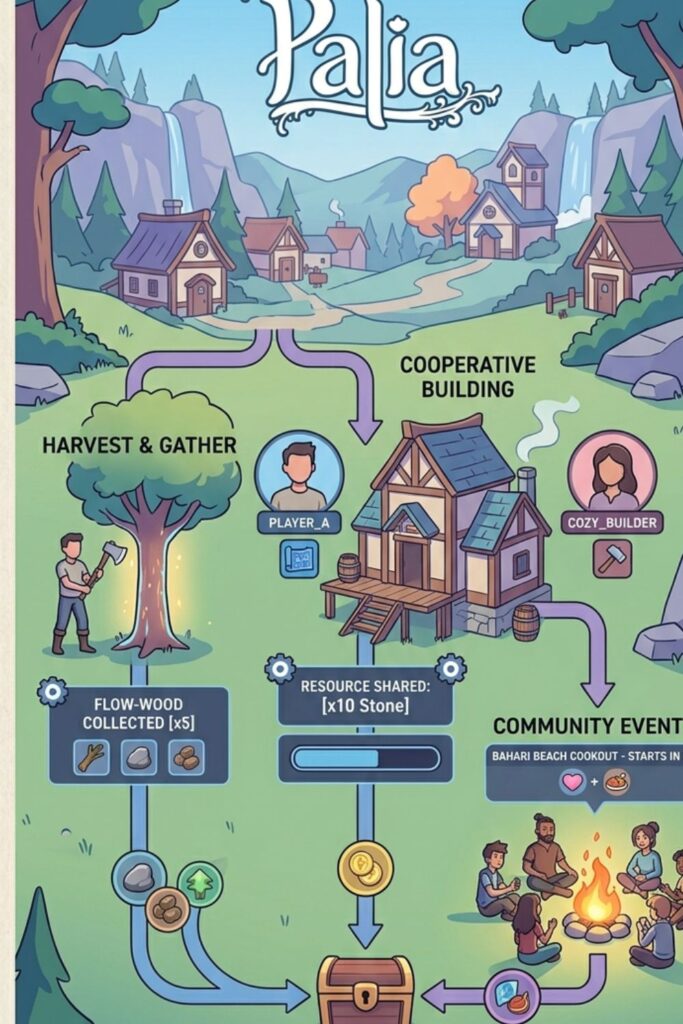
The foundation of everything is collaboration and respect for other players. You meet people who are doing the same things as you, like fishing on the pier or gathering flowers, and the nice thing is that if you share an activity, you both get the reward.
It’s a very generous system that encourages people to be kind and help each other without expecting anything in return, which I think is beautiful and very necessary nowadays.
The visual environment is one of the things that has captivated me the most. Everything has an artistic style that reminds you of animated movies, with sunsets that make you want to take screenshots every five minutes.
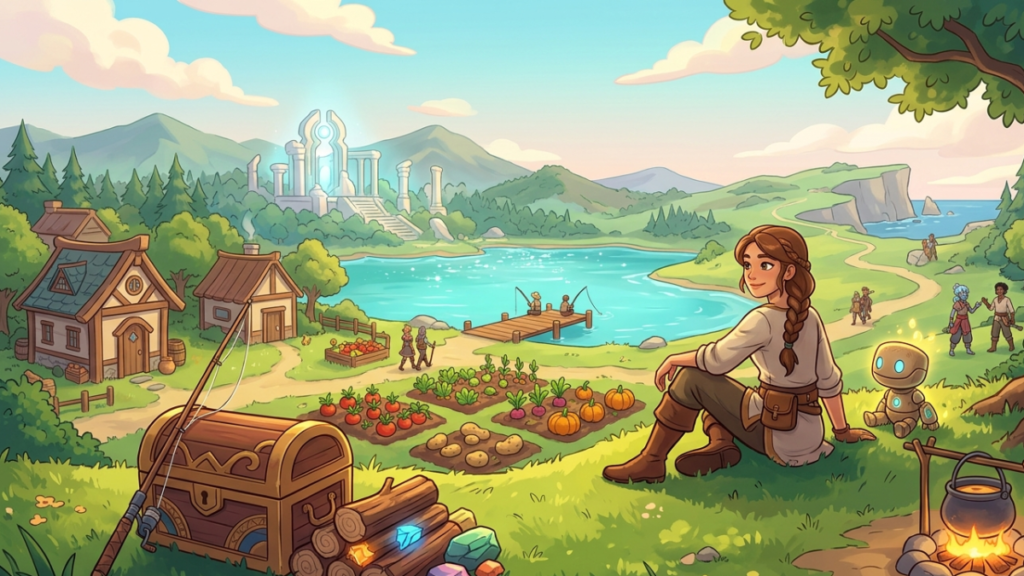
The world is mainly divided into two large areas: Kilima Village and Bahari Bay. Kilima Village is where almost all the social life takes place, where the shops and your neighbors’ houses are. It’s a cozy place, full of paths and charming little corners.
The bay is a bit wilder, with cliffs overlooking the sea and caves full of sparkling crystals. It’s the perfect place to get lost on a virtual Sunday afternoon while searching for rare materials or simply enjoying the sea breeze.
How to start your new life in Palia
At first, you might feel a bit lost because there are so many things you can do at once, but my advice is to take it very calmly. The game guides you through very simple missions that introduce you to the main characters, who are the ones that will give you the basic tools to get started.
You have an axe, a pickaxe, a hoe, and a watering can. With that, you can already start cleaning up your plot of land, which at first looks a bit of a mess but has incredible potential. The best part is that the space for building is huge, and you can keep expanding it as you get more resources and progress through the story.
One of the first things you should do is talk to all the neighbors you see around town. Each one has a very distinct personality and will teach you one of the main skills in the game. For example, you’ll meet Badruu, who is a charming farmer always telling bad vegetable jokes, or Tish, who is a carpenter with an exquisite taste for decorating.
Don’t rush to unlock everything on the first day. Enjoy every conversation and every little discovery because that’s where the real magic of this world lies. The progression feels very natural, and you always feel like you’re accomplishing something, no matter how small the advancement.
Palia farming secrets to keep your pockets full of gold
Agriculture is, without a doubt, the most relaxing and steady way to progress economically in this game. At first, you only have a few small plots of land to plant carrots and onions, but you’ll soon see that there’s a whole science behind how to place the plants.
Each crop has a special effect on the ones next to it.
Some plants help retain water so you don’t have to water so much, while others prevent weeds from growing or even improve the quality of neighboring crops. It’s like a little botanical puzzle that’s really satisfying to organize.
Personally, I love spending a little time each virtual morning tending to my garden. There’s something very zen about watching the tomatoes or potatoes grow day by day. Plus, once you start harvesting, you can use those ingredients to cook delicious dishes or sell them directly to buy that really nice piece of furniture you saw at Tish’s store.
If you want a tip that’s worked really well for me, try to diversify what you plant. Don’t focus on just one thing because you never know what ingredient you’ll need for a mission or what new recipe you might want to try. Variety is key to having a well-stocked pantry and a healthy wallet.
Friendship and building relationships with the villagers
In Palia, the characters aren’t just simple NPCs there to give you items; they have their own stories, fears, and dreams. The friendship system is really deep and lets you get to know them on an almost personal level.
You can talk to them once a day to slightly increase affinity, and you can also give them gifts. A really cool detail is that every week they have specific wishes, which you can discover by talking to them or asking their mutual friends.
If you manage to give them exactly what they want, your relationship with them will improve much faster.
There’s even a romance system in case one of the characters steals your heart. It’s all very sweet and respectful, totally in line with the game’s vibe. You can go on dates, give chocolates or wildflowers, and unlock exclusive missions that tell you more about their past.
What I like the most is that you don’t necessarily have to choose just one; you can explore the stories of several at once to see who you connect with best. It’s a great way to really feel part of the community and to feel like your actions actually impact the lives of the other residents of Kilima.
The art of gathering and discovering valuable materials
Walking through the forests of Kilima or the cliffs of Bahari is an activity that can give you a ton of surprises if you know where to look. Gathering isn’t just about picking flowers or mushrooms you see along the way, but about understanding how the game’s ecosystem works.
There are certain materials that only appear at very specific times, like the dragon fiber lily that only blooms at night and gives off a soft glow to guide you in the dark. Learning these cycles makes you feel much more connected to the environment, almost like you’re an expert naturalist exploring a pristine world.
Mining has its charm too, especially when you start looking for more advanced materials like iron or palium. The latter is a highly sought-after lilac-colored mineral that usually appears in caves or elevated areas of the bay. What I like most about mining is that, just like with flow tree cutting, it’s an activity that encourages collaboration.
If you see someone hitting a mineral vein, you can come over and give it a hit too. You’ll both receive the same amount of materials without either of you losing anything. It’s a way of playing that removes any kind of negative competitiveness and creates a really healthy sense of teamwork.
Fishing as a method of meditation and a source of hidden treasures
A lot of people think that fishing in video games is boring, but in this case, they’ve managed to make it a really fun and visual mechanic. Each body of water has its own fish, and some of them are real trophies that only show up with special bait or under certain weather conditions.
I’ve spent entire afternoons at the lagoon’s pier, just casting my line and watching the sun set behind the mountains. It’s one of the best ways to unwind because it demands just enough attention to be engaging without being stressful.
Sometimes, when fishing, you don’t just catch fish. You can find sunken chests that contain recipes for antique furniture, pieces of sunken ships, or even letters that tell you stories about people who lived there hundreds of years ago.
These small touches of environmental storytelling are what make the world feel alive and full of history. Also, the fish you don’t want for cooking or for completing your collection can be sold for a good handful of gold, especially those that are of star quality and shine in your inventory.
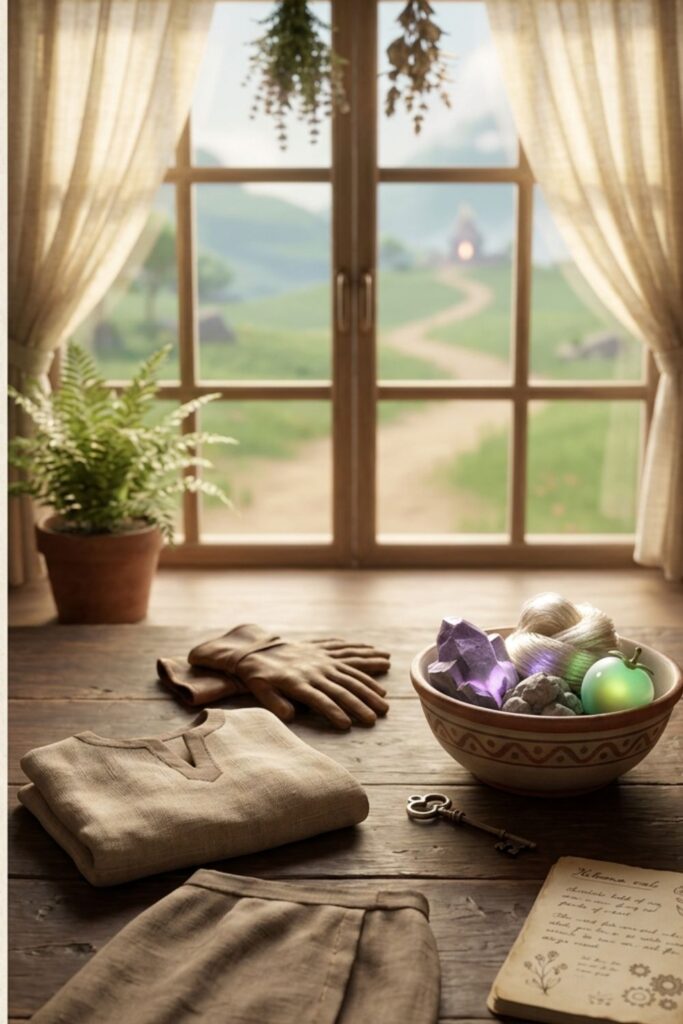
The kitchen and the joy of sharing a table with friends
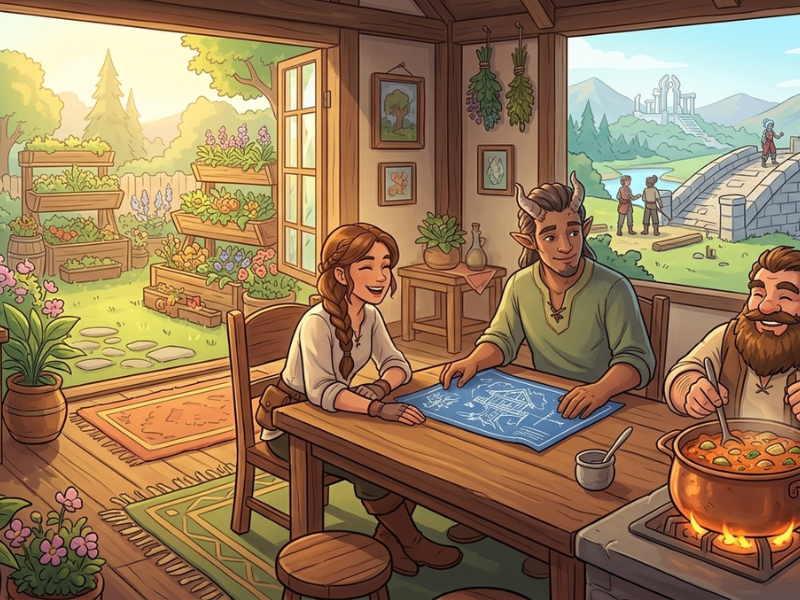
Cooking is possibly one of the most fun mechanics to do in a group. Unlike other simulators where you just press a button and the dish appears ready, here you have to interact with different workstations.
You have to chop the vegetables on the board, keep an eye on the pot so the soup doesn’t burn, and knead the flour on the prep table. If you decide to cook alone, it’s a really entertaining rhythm mini-game, but when you invite someone over, things get incredibly chaotic and fun.
Each person can take charge of a different task to finish the dish much faster. In the end, everyone gets a copy of the finished dish, making it a great social activity to save resources.
Food in this world is used to fill your focus bar, which lets you gain experience faster in any other skill. I always try to have a few cakes or meat stews ready before going out to explore. The feeling of having the pantry full of homemade dishes that you’ve made yourself is really satisfying.
Decorating your plot and building your perfect cozy home
We arrive at one of the highlights of Palia and where you’ll probably spend the most hours if you enjoy interior design. Your plot of land is a blank canvas where you can build multiple houses, connected rooms, windmills, or even small garden pavilions.
The furniture placement system is very flexible and allows you to rotate objects and place them with great precision. There’s nothing more rewarding than going from having a basic tent to owning a colonial-style mansion decorated down to the smallest detail.
There are different collections of furniture, ranging from rustic log-style pieces to industrial designs or the luxurious set of furniture from the order.
The most interesting thing is that you can’t buy most of this furniture; instead, you have to make it yourself. Every time you finish a new piece, your character has a moment of inspiration and unlocks the recipe for another item in the same collection.
It’s a cycle of progress that motivates you to keep gathering materials to see what you’ll be able to place in your room next.
The guild system and how to keep growing in the long run
Once you reach level ten in any skill, you officially enter what is considered the guild of that profession. This gives you access to a special shop where you can buy blueprints for better tools and exclusive decorative items that show off your mastery. For example, Ashura lets you buy woodworking-related things that are really nice.
Skill levels keep going up infinitely, allowing you to earn guild medals, which are a very valuable currency. These medals can be exchanged for items that can’t be obtained any other way. I like this approach because it rewards consistency and the love you put into your favorite activities.
If you’re passionate about cooking, you’ll end up being a recognized chef in town with a professionally equipped kitchen. It’s a very fair progression system that respects the time you choose to invest in the game.
Seasonal events and the life that never stops
The world of Palia is constantly evolving, and the developers often add temporary events that change the look of common areas. We’ve had night festivals with markets full of food, animal chasing games, and fireworks.
These events are perfect moments to meet other players and get decorative items that are only available for a few days. They bring a lot of life to the server and always give you a reason to log back in and see what’s new.
Even when there isn’t a special event going on, the game feels fresh thanks to frequent updates. There’s always new characters on the way, new areas of the map to explore, or furniture to add to your collection.
It’s a project that grows along with its community, and you can tell they really listen to what we players ask for. That closeness between the creators and us is something you don’t find easily in other games of this caliber.
Tips and tricks to optimize your time in the game
If you want to move ahead a little faster without losing the relaxed vibe, there are a few things you can do. Try to always have several machines working on your plot while you’re out exploring. I mean the metal smelters, the sawmills for wood, and the preserve jars for vegetables.
That way, when you come back from your adventures, you’ll have a bunch of processed materials ready to use in your constructions. It’s the best way to keep progress from stalling.
Another really useful tip is to use the fast travel points scattered across the map. While wandering around is a delight, sometimes your inventory is full and you need to fly back home.
These notice boards let you move between areas for a very small amount of gold. I also recommend always checking your home’s mailbox.
Neighbors often send you letters with gifts, recipes, or hints about secret quests. It’s one of the things I look forward to the most when I log in each day, seeing what my virtual friends have written to me.
The importance of managing focus and experience well
You’ve probably noticed that there’s a bar at the top left of the screen that empties as you do things. That’s focus, and it’s crucial if you don’t want to feel like you’re moving at a snail’s pace. It’s not an energy bar that stops you from playing when it runs out; it’s just a booster.
If you have food in your stomach and the bar is full, you’ll earn much more experience when doing any activity. That’s why I always tell you that cooking is so important. Never leave home without a few blueberry pies or vegetable soup, because you’ll be wasting precious time.
What I usually do is go to the dragon or phoenix sanctuary to spend my renown points. You earn renown by doing quests and increasing friendship levels.
In these sanctuaries, you can improve two things: the maximum amount of focus you can have and the bonus percentage that focus gives you.
At first, it seems like something secondary, but when you see yourself leveling up twice as fast as before, you realize it’s a great investment. It’s the best way to optimize your gameplay sessions without it feeling like you’re working instead of having fun.
A deep look at Bahari Bay and its minor dangers
Although I’ve mentioned that Bahari is a beautiful place, it’s also the spot where the game puts you a little more to the test. It’s not that there are monsters that will take your life, but the animals there are much trickier and the materials are more hidden.
It’s the area where you’ll find the lighthouses, the ancient flooded ruins, and those white sandy beaches that look like they’re straight out of a postcard. I love going there when I need flow wood, because there are usually groups of people organizing in the chat to go look for these magical trees.
If you decide to go on a hike in this area, make sure to bring enough arrows and several insect nets. The bugs in Bahari are fast, and some even disappear if you don’t throw the net precisely. It’s a part of the game that requires a bit more reflexes, but it’s still very doable for any type of player.
Personally, I find it super relaxing to walk along the shore collecting shells and corals while waiting for a vein of palium to appear in the nearby caves. It’s the perfect place for a change of scenery when you already know every stone in Kilima.
Chat and social etiquette to fit in with the community
You might feel a bit shy about chatting in the general chat, but I assure you it’s one of the most polite communities I’ve ever seen. There’s kind of an unwritten code that makes everything work wonderfully.
For example, when someone finds a big vein of Palium or a Flow Tree, they usually write the location in the chat and wait a few minutes for other players to arrive before starting to mine.
This is done so everyone can get a share of the loot. If you see someone write something like ‘flux in central,’ it means they’ve found a tree and are inviting you to share it.
Participating in these small collective actions makes you feel like you’re part of something bigger. You can also use the chat to ask for help if you can’t find an item for a mission or if you just want someone to come see how you’ve decorated your kitchen.
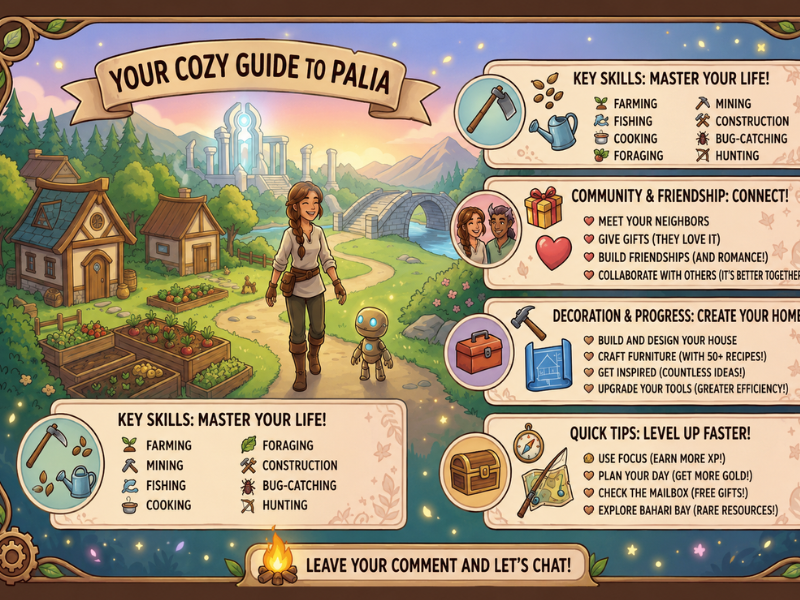
Frequently asked questions about Palia
What happens if I run out of storage space at home?
This is everyone’s problem at first because we want to keep absolutely everything. The solution is to make more storage chests, but keep in mind that there’s a limit of eight basic chests per plot. If you need more space, you’ll have to buy the blueprints for iron or copper chests at Tish’s shop.
Also, there’s a special chest you can buy at Zeki’s shop that lets you store items safely without counting toward the overall limit, though it’s pretty expensive.
How do you get the recipes to improve the tools?
You’re not going to find them while exploring, nor are they going to be given to you as a surprise. You have to go to the guild representative when you reach the right level.
For example, if you want a copper pickaxe, you need to level up mining to level three and then talk to Hodari. He’ll sell you the blueprint in exchange for gold.
Remember that higher-level tools do wear out with use, so you’ll need to craft repair kits or use the town’s repair station to keep them from breaking and reverting to their basic state.
Can I change my character’s appearance later on?
Yes, you can do it, although with some limitations. At Jel’s clothing store, there’s a fitting room that lets you change things like your hairstyle, eye color, or facial hair for free.
However, if you want to change your entire face or body type, that’s something the game doesn’t allow so easily at the moment. The clothes you choose at the beginning will always be in your wardrobe, and later you can buy much more elaborate outfits in the premium store if you feel like giving your avatar a special touch.
What are the guild medals I get for leveling up for?
Those medals are the currency for endgame items. Once you get past level ten in a skill, every time you level up, you’ll get these medals.
You can use them to buy exclusive decorations, like statues or golden tools that have amazing durability. Don’t stress about getting them quickly; it’s something that comes naturally over time, and it’s designed so that you always have a reason to keep enjoying your favorite activities.
Final tips for Palia
If I had to give you one last piece of advice, it would be not to try to compete with what you see on social media. There are people who have amazing mansions and perfectly optimized gardens, but they’ve probably been playing for hundreds of hours.
The great thing about Palia is that your progress is all yours and it never expires. There are no battle passes forcing you to play every day for fear of missing out. The game is always waiting for you just as you left it, with your plants ready to be harvested and your neighbors happy to see you again.
Take your time to explore, to read the descriptions of the objects, and to immerse yourself in the history of human ruins. There is a very interesting mystery about what happened to our species and why we have reappeared in this world inhabited by the Majiri.
It’s a plot that slowly unfolds, giving a very rich background to all the everyday activities we carry out. Enjoy every little step and let this world take care of you as much as you take care of your plot.
I hope that this whole guide and my personal experiences encourage you to give this special little corner a chance. I’m sure that the moment you set foot in Kilima and hear the relaxing music of the village, you’ll perfectly understand why I’m so excited about this game.
It’s the perfect antidote for gray days and a wonderful way to connect with amazing people from all over the world. I hope to see you there soon and hear about how you’re decorating your little home!
Don’t forget to leave me a comment down below if you have any other questions or if you want to share your name in the game so we can add each other. I would love to read your comments and grow this community together!