
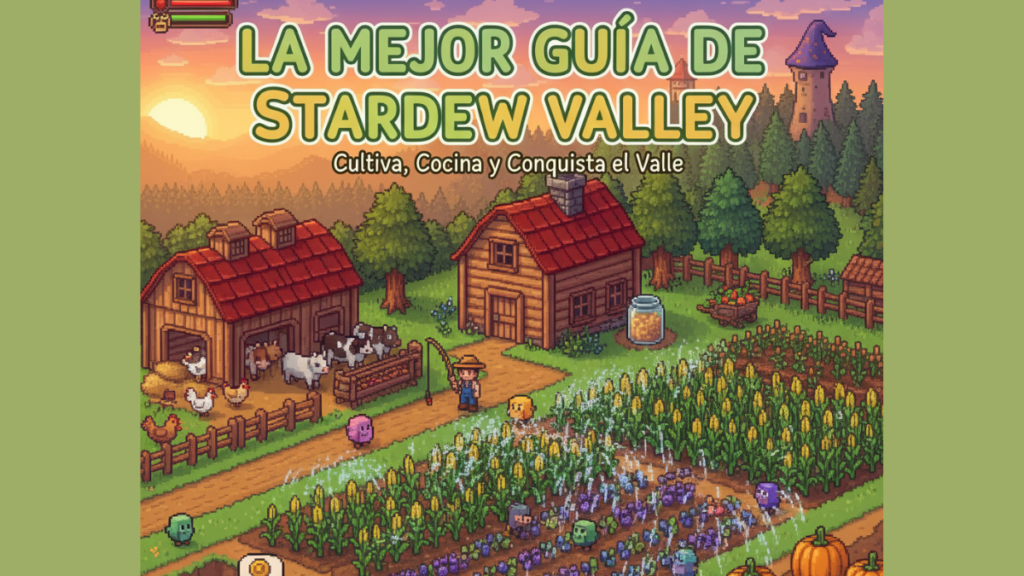
Discover how to get started in Stardew Valley from scratch with this ultimate guide. Learn farming, fishing, mining tricks, and the best cooking recipe to maximize your energy. Master your farm today!
Have you ever felt that irresistible urge to drop everything, turn off your phone, and move to a little house in the countryside to grow your own tomatoes? I have, countless times. Luckily for my bank account, I discovered Stardew Valley before I bought a pair of real farmer’s overalls.
If you’ve just inherited your grandfather’s old farm in Pelican Town, you’re probably looking at that overgrown plot of land, full of rocks and logs, with a mixture of excitement and panic. Don’t worry, I was there too. At first, it seems like there aren’t enough hours in the day and your character gets tired just looking at the hoe. But I promise you that, with a little practice and the right advice, you’ll be living the life you’ve always dreamed of in no time.
A Farmer’s Awakening: Your First Steps in the Valley.
When you arrive at the farm, the first thing you receive is 15 packets of parsnip seeds. It’s Mayor Lewis’s welcome gift. My first piece of friendly advice: don’t ignore them. Farming is at the heart of this game, but it’s not the only thing.
Before you rush headlong into clearing the entire plot of land (a very common mistake that will leave you exhausted by 10 a.m.), take a breath. Look around. You have a huge map full of possibilities. Stardew Valley is a rhythm game, not a 100-meter dash.
Choose your land wisely.
Did you know that your map choice at the beginning drastically changes your experience?
- The Standard Farm: It’s the best for those of us who, like me, love order and want plenty of space for crops. It’s the perfect blank canvas.
- The River Farm: beautiful, full of bridges, but a bit stressful if you want to plant acres of corn. However, it’s wonderful for fishing from the porch.
- The Forest Farm: my personal favorite. You have access to forage (wild food) and hardwood much faster.
Which one best suits your personality? If you like to have everything under control, go for the standard one. If you’re a free spirit who prefers to explore, the forester will steal your heart.
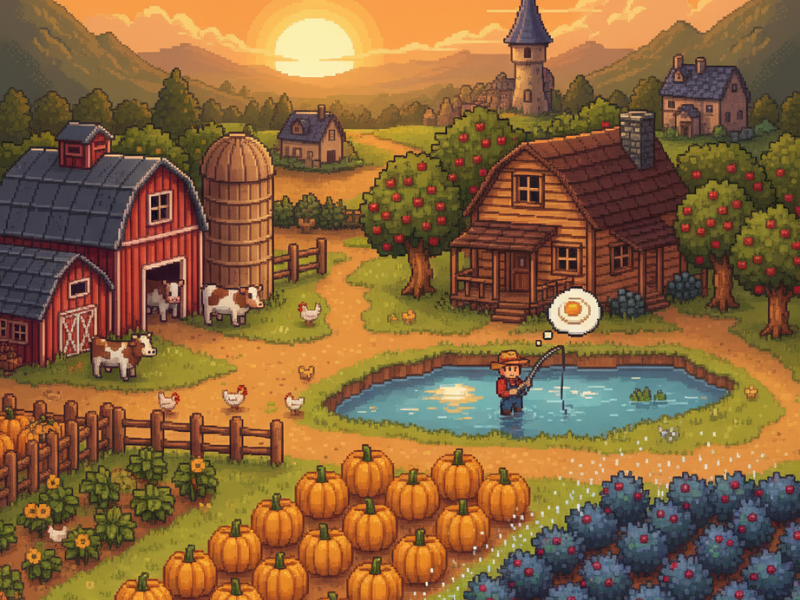
Energy Management: Your Most Valuable Resource.
At first, your energy bar is terribly small. You chop down three trees, mine four rocks, and bam! You’re exhausted. This is where my inner cook comes in. In Stardew Valley, eating isn’t a luxury, it’s a strategic necessity.
Don’t make the mistake of selling everything you gather. In the beginning, the leeks, wild radishes, and dandelions you find on the ground are your best allies—save them. They’re your natural “energy bars” to keep you going a little longer in the mine or cleaning the garden.
What to do when you run out of energy?
If you get the warning that you’re exhausted, stop! If you keep working, you’ll wake up the next day with only half your energy. At those times, the best thing to do is go into town and talk to the locals. Socializing doesn’t use up energy, and it’s essential for progressing through the story and getting exclusive recipes.
The farmer’s calendar: what to plant and when.
Each season in Stardew Valley is almost like starting a new game. The landscape changes color, the atmosphere shifts, and so do the opportunities. Not only do different fish and new items appear on the ground, but Pierre’s shop completely updates its seed catalog. Understanding this from the beginning makes a huge difference in how you progress and how you feel while playing.
Planning what to plant each season saves you frustration, gives you financial stability, and allows you to enjoy the valley more without always feeling like you’re behind on everything.
Spring: the awakening.
Spring is your first real taste of farming. Everything is new, you have little money, and a lot of enthusiasm. The key here isn’t to try to do everything, but to start with crops that will allow you to recoup your investment quickly.
Parsnips are the perfect starting point. They’re cheap, grow in just four days, and help you generate your first profits risk-free. Thanks to them, you can start reinvesting early and try other crops at a more leisurely pace.
Cauliflowers take considerably longer to grow, twelve days, but sell for much more money. Planting some at the beginning of the season pays off, as long as you don’t put all your eggs in one basket.
Strawberries are one of spring’s best-kept secrets. You can’t buy them from day one; they’re only available during the Egg Festival, which takes place on the thirteenth. Saving up for that day is well worth it. Even if you only get a couple of harvests before the season ends, their profitability is extremely high, and you’ll see results right away.
Green beans are also a good option, but you need to be careful when planting them. They need support and you can’t walk through them, so it’s best to plant them in well-planned rows so they don’t block your path around the garden.
Summer: the heat of gold.
Summer is, for many people, the season when things really start to take off. Crops are more profitable, and if you’ve done things reasonably well in spring, you’ll be much more financially secure by now.
Blueberries are the star crop of summer. Once they grow, they continue to bear fruit every few days without needing to replant seeds. This makes them a constant source of income and one of the best crops to start with.
Melons work similarly to cauliflowers. They take a while to grow, but they sell very well. They also have the potential to become a giant crop if planted in three-by-three blocks, which is always exciting when it happens.
Starfruit is the most profitable crop in the game, but it’s not available from the beginning. To get its seeds, you need access to the Calico Desert. At the start of summer, it’s normal to focus on blueberries, but it’s worth keeping starfruit in mind as a medium-term goal.
Autumn: the abundant harvest.
Autumn has a special atmosphere, with muted colors and a sense of closure. Even so, it’s a very productive season if you don’t get too relaxed.
Cranberries work just like summer blueberries. You plant once and harvest several times throughout the season, making them a very profitable and convenient option.
Pumpkins are practically essential. They provide good financial returns, but they’re also used in various recipes and in different Community Center projects. Having some on hand is always a good idea.
Grapes, like green beans, are grown on trellises. It’s important to think carefully about where to plant them so as not to obstruct movement around the farm.
Winter: the warrior’s rest.
Normal crops don’t grow in winter unless you already have access to the greenhouse. This doesn’t mean it’s a wasted season, not at all. It’s the ideal time to focus on other aspects of the game.
During these months, you can go down into the mine, upgrade your tools with Clint the blacksmith, or spend more time fishing. You can also plant winter seeds, which are crafted from items you find on the ground, such as winterroot or snow fruit. It’s not a huge source of income, but it helps keep you active.
The Civic Center: the heart of the valley.
The Civic Center is central to much of the progression in Stardew Valley. Shortly after starting, the mayor will take you to this abandoned building where small creatures called Junimos appear.
Completing the Civic Center lots isn’t just about aesthetics or narrative. Each completed lot unlocks significant upgrades that completely change your daily life in the valley.
Repairing the bus grants you access to the Calico Desert. Fixing the quarry bridge gives you access to extra resources each day. Activating the minecart allows you to travel quickly across the map and saves you from endless treks.
Mining and combat: dangers underground.
Starting on the fifth day, the mines north of the village open up. This is where you get copper, iron, and gold—essential materials for crafting sprinklers and upgrading tools. Hand-watering large areas of crops consumes a lot of energy and time, so progressing in the mine is key to automating your farm.
It’s always a good idea to carry food with you. A seaweed scramble or some simple berries can make all the difference when your energy or health starts to run low.
Levels that are multiples of five unlock the elevator. Going down gradually and activating these checkpoints saves you from having to start from the top every day.
Checking the television in the morning also helps a lot. The oracle program tells you whether the day will be lucky or unlucky, which directly influences how quickly you find ladders in the mine..
Socializing: Winning the hearts of Pelican Town.
Sometimes, it’s easy to get so caught up in efficiency that we forget Stardew Valley is also about people. Each villager has their own personality, routines, and story.
You can give up to two gifts per week to each character, and birthday gifts have a much greater impact. Keeping track of dates is incredibly helpful.
Linus, who lives near the mines, is often overlooked, but befriending him is very useful. He teaches you important recipes, such as the high-quality fishing bait.
Caroline is also a great friend to start with. By earning two hearts and visiting her tea shop, she’ll give you the recipe for tea pots, an easy way to earn extra income.
Details so you don’t miss anything.
Your game is only saved when you go to sleep. If you close the game before then, you’ll lose your progress for the day. It’s also a good idea to get to bed before 2:00 AM to avoid penalties.
Television is an essential tool. The weather channel warns you about rain, the luck channel helps you plan your mining or fishing trips, and Salsa Queen teaches you new recipes every Sunday.
Items with stars indicate higher quality. At the beginning, it’s usually worth selling the gold-quality items and keeping the regular ones for food or for Community Center bundles.
Farm buildings can be moved by talking to Robin at his carpentry shop. It’s okay if you initially place something somewhere you later regret.
Which villager did you dislike the moment you met them? I had a lot of doubts about Shane at first. Tell me about it in the comments.
Livestock: Your New Best Furry (and Feathered) Friends.
Having animals isn’t just about making your farm look pretty. It’s a steady source of income and, above all, the key to the best recipes. To get started, you’ll need Robin to build you a chicken coop (for chickens) or a barn (for cows).
The Secret of Happy Animals.
It’s not enough to just lock them up. The animals in this game have feelings, they really do!
- Pet them every day: right-click on them. You’ll see a little heart appear. The more hearts they have, the better products they’ll produce (large eggs, XL milk).
- Don’t forget the hay! If they don’t have food in the feeder, they’ll get restless and stop producing. In winter, this is vital because there’s no grass outside. Build a silo before building the farmyard; that way, when you cut the grass on your farm with the scythe, it will automatically turn into stored hay.
- Freedom has its rewards: if the weather is nice, open the trapdoor so they can go out to graze. Fresh grass makes them much happier than dry hay.
Handcrafted Products: Multiplying Value.
Selling an egg is fine, but selling mayonnaise is much better. As soon as you can, build a mayonnaise maker and a cheese press. It’s the first step to turning your farm into a true gourmet operation. Besides, golden cheese is one of the best foods to take with you to the mines: it restores a huge amount of health and energy.
Fishing: Patience, Steady Hands, and Many Treasures.
I know what you’re thinking: “Fishing is so hard!” At first, the green bar goes up and down like crazy and the fish seems to be laughing at you. Don’t despair, it’s just a matter of practice and improving your skill level.
Tricks to avoid losing your temper while fishing.
- Start with the Training Rod: Willy sells it in his shop for only 25 coins. It limits you to common fish, but it makes the green bar bigger. It’s perfect for leveling up your first few skill levels.
- Short taps: Don’t hold down the button. Tap quickly and rhythmically to keep the bar over the fish. It’s like a dance.
- Treasure Chests: Sometimes a chest will appear while you’re fishing. If you manage to catch it along with the fish, you can find anything from coal to diamonds or rare weapons.
Where and When to Fish?
The river, the mountain lake, and the sea have different fish.
- If you want quick money in the summer, go to the sea at night to fish for Supercucumbers.
- If you need fish for the Civic Center, check the weather; some only come out when it rains, like the elusive catfish.
Automation: Let the Farm Work for You
There will come a point when you have so many plants that you spend all day watering them. That’s no life. That’s what sprinklers are for.
- Basic sprinkler: only waters 4 spaces. Honestly, they’re not really worth the effort to make.
- Quality Sprinkler: A game-changer! Waters the 8 surrounding spaces (a 3×3 square). As soon as you reach level 6 in Farming, craft as many as you can.
- Iridium Sprinkler: every farmer’s dream, it irrigates 24 spaces. They’re acquired later, but they allow you to have gigantic fields without lifting a finger.
Frequently Asked Questions about getting started in Stardew Valley
What is that statue of the grandfather on the corner of the farm?
It’s a sanctuary. At the beginning of the third year, the grandfather’s spirit will return to assess your progress. If you’ve been a good farmer, he’ll give you an incredible gift that produces iridium every day. Don’t worry, if you don’t succeed the first time, you can request a re-evaluation later.
What are old fruits used for?
These are the rarest and most valuable seeds in the game. If you find an “Ancient Seed” (a small, blue artifact), give it to Gunther in the museum. He’ll give you a packet of seeds that you can plant. Don’t sell them! Put them in a seed maker to get more. Ancient Fruit Wine is what will make you a millionaire.
Is it better to sell the items directly or to process them?
It’s almost always better to process them. Milk into cheese, eggs into mayonnaise, fruit into wine or jam, and vegetables into pickles. The nutritional value usually doubles or triples.
What happens if I die in the mines?
You’ll wake up in the entrance or the clinic. You’ll lose money and some items from your inventory. If you lose something very important (like your favorite sword), you can go to the Adventurers’ Guild the next day and ask Marlon to retrieve it for you for a fee.
How do I get hardwood?
You need to upgrade your axe to bronze or iron. With the bronze axe you can break large fallen logs, and with the iron axe, you can break stumps. Hardwood is necessary for building the stable and for repairing important things.
What is the purpose of the train that passes through the north?
Sometimes a message will appear saying that “a train is passing through Stardew Valley.” If you run quickly to the tracks (above the mountain area), you’ll see the train drop items like coal, wood, or even geodes. It’s like a giant piñata on rails!
How do I get the cooking recipes?
There are three main ways: watching the show “La Reina de la Salsa” on TV on Sundays, increasing your friendship level with the neighbors (they will mail them to you), or buying them at Gus’s Salon.
What is the Mobile Cart?
She appears on Fridays and Sundays in Tizón Forest (south of your farm). She sells rare items and, although sometimes expensive, is essential for obtaining the Gem Sweet Fruit seeds or rare fish you need for the Community Center.
Can I get a divorce in the game?
Yes, although it’s a bit sad. If things aren’t working out with your partner, you can go to Mayor Lewis’s cabin and file for divorce for a sum of gold. There’s also a shrine in the Witch’s house where your ex can forget you were ever married. Stardew Valley has drama galore!
How do I get the greenhouse?
Completing all the pantry items in the Community Center is arguably the most important upgrade in the game, as it allows you to plant any crop in any season, even winter!
Health and the Stars: The Path to Perfection.
Unlike energy, which is consumed by working, health only decreases if you take damage (usually in the mine from those pesky slimes or bats). If your health reaches zero, you’ll faint and wake up in Harvey’s clinic, having lost money and, even worse, valuable items from your backpack!
Stardrops: The Treasure of the Valley.
Have you noticed that your maximum energy bar can increase? That’s achieved by eating Star Fruits. They’re rare, mystical, and taste like “your favorite thing” (the one you wrote down when creating your character).
- There is one on level 100 of the mines.
- Another one is sold by the merchant at the Stardew Valley fair in autumn.
- Even your spouse will give you one when your relationship is perfect. Every time you find one, your life on the farm will be much easier because you’ll get less tired.
The Art of Gift Giving: A Guide to Social Survival.
Not all gifts are created equal. If you give Abigail a rock, she’ll eat it (yes, literally), but if you give one to Haley, she’ll be deeply offended. This is where your observational skills come in.
Universal Gifts That Never Fail.
If you don’t want to take risks, there are things that almost everyone loves:
- Diamonds: They’re expensive to get, but they’re a sure bet with almost everyone.
- Coffee: the adults in town love it. You can buy it at Gus’s Star Fruit Lounge.
- Mayonnaise: almost all the neighbors appreciate it (except the children, watch out!).
Friendly tip: Always check the calendar outside Pierre’s shop. Birthdays are the perfect opportunity to instantly boost someone’s morale. A quality birthday gift can make you go from a stranger to someone’s best friend in a single day.
Events and Festivals: It’s Not All Work.
Each season has two main festivals. They’re not just for socializing; they have unique prizes you can’t get any other way.
- The Egg Festival (Spring 13): Like I told you before, buy strawberry seeds! And get ready for the egg hunt. If you beat Abigail, you’ll win a really cool hat.
- The Luau (Summer 11): Here, the village makes a communal soup. Bring something high-quality (like a golden cauliflower or a golden melon). If the Governor says the soup is delicious, you’ll gain friendship points with all the villagers at once. Don’t even think about bringing lucky shorts or anything unusual!
- Stardew Valley Fair (Fall 16): It’s time to show off your best products at the booth. Bring a mix of 9 items: something mining-related, something cooking-related, a fruit, a vegetable, an animal product… Variety is key to winning!
Organization and Aesthetics: Your Farm, Your Rules
As you progress, space becomes an issue. Don’t let the undergrowth get the better of you.
Intelligent Design
- Paths and Floors: They’re not just decorative. Placing paths prevents weeds or rocks from growing and damaging your machines or fences. Plus, walking on them gives you a small speed bonus!
- They break quickly, try to upgrade to stone or iron fences as soon as you can.
- Color-Coded Chests: Organize your chests by category (Mining, Fishing, Foraging, Seeds). I usually use blue for fishing, gray for mining, and green for nature. This will save you hours of searching for that item you swore you had stored away.
The Importance of the Seasons: Preparation for Year 2.
The first year is for learning, but the second is for shining.
- Always save some seeds: if you have a seed machine, save your best fruits to create new seeds. This way you won’t depend so much on Pierre’s shop and you’ll save a lot of money.
- Fruit trees: they take a whole month to grow. If you want fruit in the summer, you have to plant the trees in the spring. Plan ahead, because they are an expensive investment, but they bear fruit (literally) every single day of their season.
Professional Tools: Iridium and Beyond.
Upgrading your tools with Clint is vital. Each upgrade level (Bronze, Iron, Gold, Iridium) not only makes the tool more efficient, but also unlocks new features:
- The Watering Can and the Hoe: By holding down the action button, you will water or till larger areas (3 spaces, 5 spaces, or even 3×6!).
- The Axe and the Pickaxe: will allow you to break down logs of fine wood and meteorite stones that were previously impossible to move.
Your New Life Starts Now
Stardew Valley is a constant reminder that good things take time. Don’t get frustrated if you don’t get everything right at first. The magic of this game lies in waking up each morning, checking if the sun is up, and deciding what you want to do that day. Whether it’s fishing at the pier, exploring the mines, or simply watching your sunflowers grow, the important thing is that you enjoy the process.
I hope this guide will serve as your compass for your first steps in the valley. It’s been a pleasure to accompany you on this farming journey.
Where can you find Stardew Valley?
PCs and Computers
It’s where the game was born and where updates usually arrive first.
- Windows (PC).
- macOS.
- Linux.
- Bonus fact: You can buy it on Steam, GOG, or the Microsoft Store.
Desktop Consoles
Ideal for playing on a big screen and relaxing with the controller.
- Nintendo Switch: `probably the most popular platform for this game because of its portable mode.
- PlayStation 4 and PlayStation 5.
- Xbox One, Xbox Series X and Xbox Series S.
Mobile Devices
To literally carry your farm in your pocket.
- iOS (iPhone, iPad).
- Android (Mobiles and Tablets).
Other Platforms
- PlayStation Vita:Although it no longer receives the newest updates (like 1.6), the base game is still there.
A pro tip: If you like customizing the game with mods (such as adding new recipes, furniture, or even fan-created story expansions like Stardew Valley Expanded), the PC/Mac version is the only one that allows you to do so easily and completely.